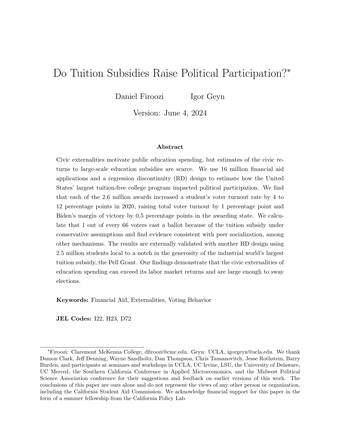
AEJ: Policy · 2025
Using California's Cal Grant and a GPA cutoff, we estimate the causal effects of financial aid on voter registration and turnout. With D. Firoozi.
I'm a data scientist and researcher in the Bay Area working on elections, representation, and public policy. I build causal-inference analyses on large administrative datasets and ship the results as peer-reviewed articles, public data tools, and applied reports. PhD in political science (UCLA); published in the American Political Science Review and AEJ: Policy.
Using California's Cal Grant and a GPA cutoff, we estimate the causal effects of financial aid on voter registration and turnout. With D. Firoozi.
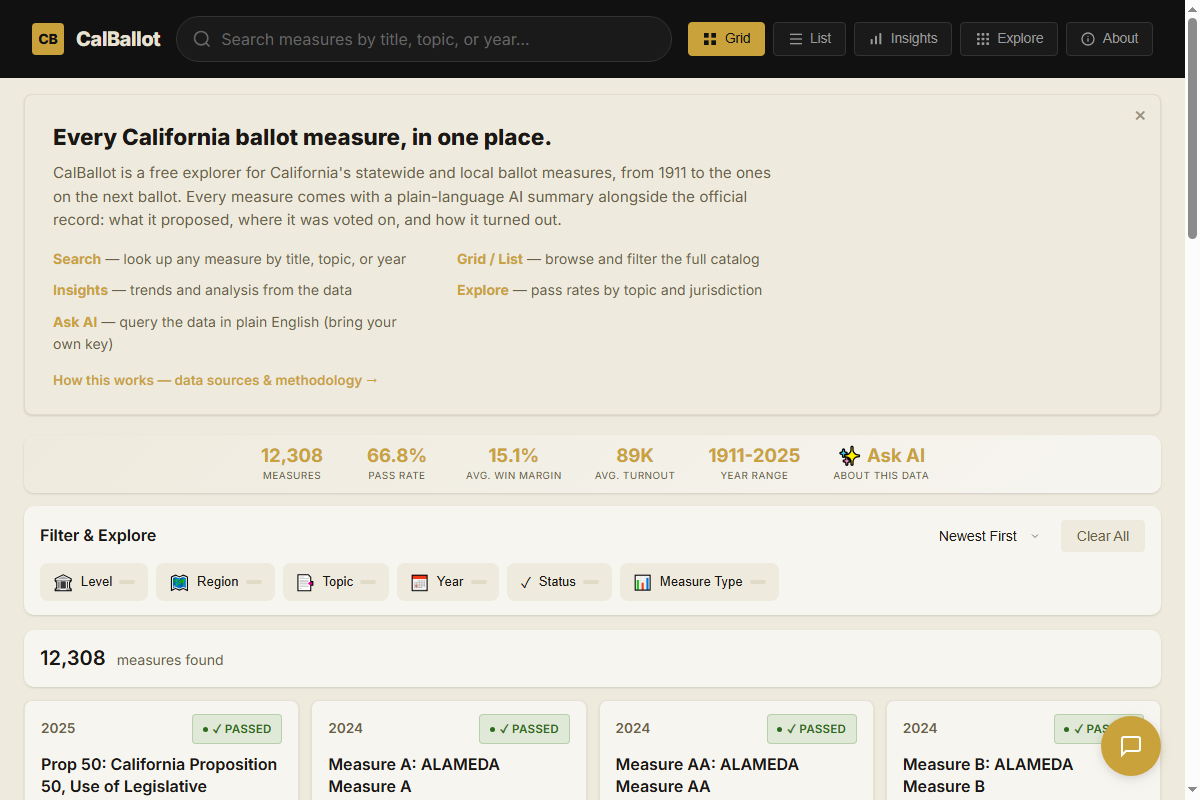
12,000+ California ballot measures, 1911–2026, with plain-language AI summaries and an in-browser query engine.
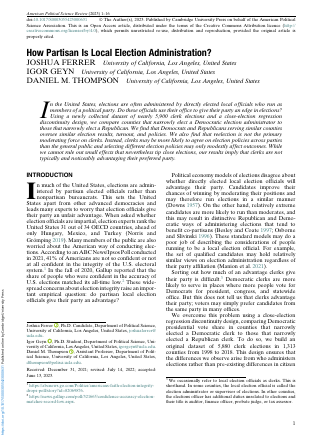
Close-election RD on county clerk races: partisan local election officials do not tilt electoral outcomes. With J. Ferrer and D.M. Thompson.
Using California's Cal Grant and a GPA cutoff, we estimate the causal effects of financial aid on voter registration and turnout.
Using regression discontinuity around close clerk elections, we test whether partisan local election officials affect electoral outcomes.
A comprehensive analysis of local election officials, including their authority, demographics, and institutional variation across states.
Using CVRA-induced transitions to single-member districts across 721 California school districts, I show that electoral reform did not narrow the Black–White suspension gap—an informative null explained by an asymmetric first stage: reform raised Hispanic, not Black, board representation. Minority representation is not fungible across groups.
Using 1,547 ballot measures merged with 480K survey responses, I examine whether direct democracy increases voters' policy knowledge under modern DiD estimators.
Using an RD design around close House elections, I test whether the president's party shapes FEMA relief and examine the role of disaster vulnerability.
Searchable database of 12,000+ California ballot measures across all 58 counties, 1911–2026.
First publicly available analysis of D.C.'s health workforce. Combined ACS data, FOIA records, and original geocoding.
Last updated July 2026.